
Why Do Men Have Beards?: An Evolutionary Explanation
Also: A Very Considered And Laudatory Review For The Primate Myth From A Scientific American Editor

One of the mysteries of human evolution is why men have beards. I have an answer to that question. But to grasp it we need to throw out the primate models for human thought and behavior that have dominated anthropology for decades.
The gist of my argument is below.
More immediately, please permit me to note that my book on the subject of human nature and human evolution received another laudatory review yesterday. This one appears on Splice Today, and it’s by one of the most respected living science journalists, Kenneth Silber. He has worked for many years as an editor for Scientific American.
He writes that my book is “a well-marshaled argument that behaviors of chimpanzees, gorillas and other great apes don’t give much insight into how humans act. Its author, Jonathan Leaf, makes a strong case that primatologists have overstated similarities between human and great-ape behavior and biology over the past half-century. Leaf provides a current, well-informed brief against a school of thought once mocked by neurobiologist Steven Rose as ‘chimpomorphs.’”
He goes on to emphasize the book’s overall importance and to ask what writers and thinkers on different parts of the political spectrum will be saying about it.
And this morning British journalist Ed West named it one of his two favorite books of the year.
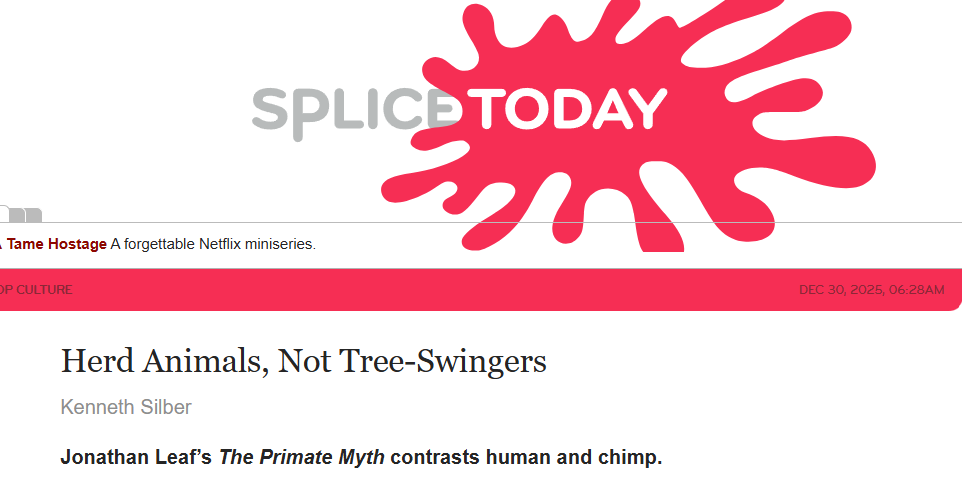
Here’s the Splice Today review: https://www.splicetoday.com/pop-culture/herd-animals-not-tree-swingers
To bring in the New Year in the best possible way, purchase your copy of the book by going to: https://www.amazon.com/Primate-Myth-Latest-Science-Theory/dp/B0F27ZZ9ZN
But beards, yes?
Beards are secondary sex characteristic. These are sexual identifiers. Famous examples of this are a peacock’s feathers and a lion’s mane. These serve the evolutionary function of telling females that a male is strong and healthy.
In my book, I discuss possible explanations for a number of secondary sex characteristics seen in humans. One is breasts. We are the only species in which females have permanent breasts, and I offer an explanation for why this is that readers have said is highly plausible.
I don’t discuss beards though. They are particularly odd in that they make men less attractive. If you have any doubts about this, ask yourself how many male movie stars are known for their beards. There have been beloved screen actors like Clark Gable and Burt Reynolds who had moustaches. Not beards though. And, in general, women clearly prefer men who are clean-shaven. So, the phenomenon appears to violate a basic Darwinian principle of sex selection.
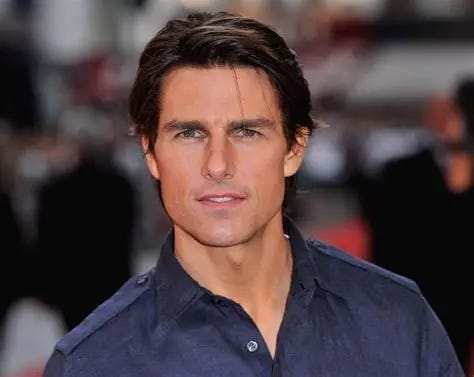
Tom Cruise: Typically shorn.
There is an explanation, however. In fact, there are two.
To some degree, whether male facial hair is considered desirable is arbitrary and guided by the whims of fashion. The recent hipster beard craze was mostly a typical fad in which something that had been “out” for a long time promptly became de rigueur. This fits in with my argument that humans are more of a herd animal than a primate.
But there’s more to the story. Look around the world today and to the past societies in which beards were most prized. Ancient Mesopotamia is an example. Ancient Greece was another. Viking men were virtually obligated to have big, bushy beards. They were also a cherished attribute of Civil War Generals, and most of the prominent ones had them, including Robert E. Lee and Ulysses Grant. Most famously, the term sideburns comes from Union General Ambrose Burnsides. Beards are also revered and a point of pride among Islamists, as they have been among the Sikhs who appeared in Northern India during the 1600s, launching themselves as warriors in opposition to their would-be Muslim conquerors. Now, ask yourself: what do these groups have in common? They are all patriarchal cultures in which men have sought respect from other men over and above women.
Beards hide the expression of feeling. That can make men seem more masculine. But women generally want men to show emotions, and so they tend to make men less fetching to women. That’s significant as we are a pair-bonding species in which men must work to win women’s favor. Moreover, beards are problematic in modern, advanced cultures in which trust with strangers is vital. That’s why police are often asked to shave them off.
Nonetheless, the process of evolution which made humans into a distinctive species largely occurred when we were hunter-gatherers. We lived in tightly-knit tribes that greatly venerated male bravery. Hunting can be a dangerous business, and within these groups, in order to gains status, men likely placed particular emphasis upon gaining the respect of other men. This favored the growing of beards and the control (or concealment) of emotion.
Thus, men evolved to have and to grow beards, but males in most Western cultures — with their greater sexual equality — are encouraged and rewarded for using a razor and lopping them off. So, the popularity of beards implicitly tells us about how women are regarded by men. In Islamic cultures where men have control over whom women are to marry, it makes sense that men feel free to grow them out and to admire other men for doing so. There’s no loss of face — so to speak — for hiding one’s cheeks. That means that the fewer beards you see, the more that men are apt to be focused upon pleasing women. The more you see, the less.
Happy New Year, everyone! Thanks for reading and subscribing and paying (if you are paying). Stay safe and well, whatever your feelings about facial hair might be.
Now do nipples.
Thank you, Jonathan. For the record, I'm a longtime editor for Scientific American but on a contract basis, and ongoing. Very pleased to give deserved notice to The Primate Myth.