
A short, CRITICAL History of Philosophy - Chapter 63
A Look At Judith Butler and Intersectionality

It would be hard to think of anyone with as much influence on contemporary American philosophy as Judith Butler. That she attained this high status is remarkable as she is a notoriously bad writer and her thinking is slipshod.
Most notable, however, is the way in which she has been read – perhaps we should say misread – so that her ideas are seen as progressive and in alignment with feminist and gay politics, though they are anti-feminist and anti-gay.
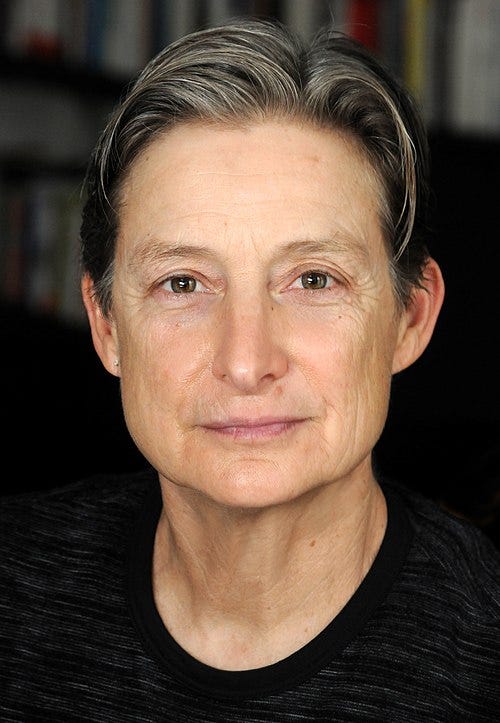
Judith Butler showing her face as it would not be permitted in any country that she would claim as an “intersectional” ally.
Notwithstanding this, Butler is one of the most assigned writers in American colleges and universities. Indeed, a study by Open Syllabus found that her compositions are being given to more American college students than Plato’s. Butler is not so much a phenomenologist as a phenomenon.
Butler refers to herself with non-binary pronouns, and descriptions of her work and accounts of her life invariably employ these. But Butler is not a “they.” She’s a woman. Her rejection of the terms her and she and more broadly of the concept that a woman is someone with breasts and ovaries finds its intellectual antecedent in Simone de Beauvoir’s The Second Sex. That polemic set forth a series of justified complaints about the historical position and treatment of women, and for this reason it’s widely regarded as a seminal feminist text. In many respects though it is anti-feminist as de Beauvoir makes the false and unscientific claim that male and female embryos might not be distinct. In effect, de Beauvoir was denying the unique and special attributes of womanhood. There is also evidence that she assisted her lover, Jean-Paul Sartre, in abusive treatment of young women who came into their hands. Regardless, it is to the credit of influential later feminist authors that they have rejected this notion and celebrated “difference.”
Let us back up for a moment though. Who is Judith Butler? Where did she come from? And how did she achieve such prominence?
Born into an upper middle-class Jewish family and reared in a prosperous suburb of Cleveland, Ohio, Butler attended a private elementary school and a reform synagogue. Her father was a dentist. After graduating high school in 1974, Butler matriculated to Benington College. This was when Benington made a point of advertising itself as the most expensive college in America. Butler transferred from it to Yale.
Most people who go to school in New Haven rapidly develop an urge to leave it in order to encounter the larger world. This was not her impulse. Much as she loved the cloistered academic world, she remained there for five of the next six years after her college graduation. The one year she did not spend in New Haven pursuing a doctorate in philosophy was occupied in a sojourn to Heidelberg, Germany, an equally diminutive university town. The whole rest of her life since has been spent on college campuses: Wesleyan, George Washington University, John Hopkins, the University of Amsterdam, and Berkeley. It’s not clear that she has ever had anything that could be described as a real job.
Perhaps in consequence, Butler seems not to have any great interest in philosophy grounded in anything concrete or material. Here’s a list of the authors that are most often said to have influenced her: Hegel, de Beauvoir, Lacan, Derrida, Merleau-Ponty, Kojève and Foucault. The title of her first book is indicative: Subjects of Desire: Hegelian Reflections in Twentieth Century France. Its subject is the relation between sexual identity, the “other,” desire and consciousness, and it is every bit as painfully pretentious and tedious as its title would suggest. Reading Butler is like drinking castor oil, but with the difference that while it’s just as unpalatable it’s harder to eliminate.
Butler’s celebrity starts with a simple idea: sexuality and gender are performative. Butler does not contest the idea that there are observable biological differences between men and women. However, she argues that how we present ourselves – whether as male or female, or something else – is socially conditioned.
In her words, “The misapprehension about gender performativity is this: that gender is a choice, or that gender is a role, or that gender is a construction that one puts on, as one puts clothes on in the morning, that there is a ‘one’ who is prior to this gender, a one who goes to this wardrobe of gender and decides with deliberation which it will be today. This is a voluntarist account of gender which assumes a subject, intact, prior to the gendering. Gender is performative insofar as it is the result of a regulatory regime of gender differences in which genders are divided and hierarchized [sic] under constraint.”
This is taking off from the ideas of Michel Foucault in suggesting that an unseen “regime” exists, and it controls our ability to identify and “be” one thing or another: male, female, gay, straight, or an indeterminate number of other “genders.”
This idea appeals to an enormous number of intellectuals. It would be even more accurate to say that it flatters them. Like a pat on the head or a warm glass of milk with an oatmeal cookie before bedtime, it’s soothing. Yet it fails to answer some simple questions: Are there really so many genders? And is gay liberation impossible and always in conflict with the “regime”? To Butler the persistent existence of the regime is an undeniable fact within our present system of law and governance.
Convinced that there must be a means to overcome this oppression, Butler proceeded to put forward her idea of intersectionality. This is the belief that those who constitute the “other” should necessarily be allies – brothers and sisters (if one can use such gendered terms). According to this theory, it makes sense within Western society for devout Muslims to be working towards their common goals alongside gays and feminists. Hence, the bizarre phenomenon by which one sees “Queers For Palestine” protests – even though the leaders of Hamas regularly call for killing homosexuals and under their rule in the Gaza Strip women were not even second-class citizens.
Butler has also criticized the Geneva Convention. The purpose of that accord was to define the rules of war and to prevent deliberate acts of wartime cruelty and unnecessary bloodshed. Thus, it requires soldiers to wear uniforms and not to employ civilian populations as their shields. Butler sees this as a means by which powerful nations undermine her intersectional allies. A more rational person, of course, might instead label these same actors as terrorists. Evidence that this is so comes from those she cites as victims of the system adopted under the Geneva Convention: the figures behind the 9/11 attacks who are being held in Guantanamo Bay, Cuba.
As someone both gay and Jewish, you might think that Butler would be acutely aware that these “intersectional” allies are not her friends. Yet her life has been spent outside the real world, and her philosophy is founded in fantasy and hatred of the establishment. Among the many ironies of her career is that there is a regime controlling her: the faculty lounge and the graduate seminar. But she is unaware of this, as are her acolytes.
The fad which has arisen in which young people tell you their pronouns finds its wellspring in Butler’s writings. Not surprisingly many comedians have found rich fodder in it. What, though, is the source of the joke and of the fascinated adoration that many radicals hold for non-Western governments and societies that reject personal freedom and pluralism? In considerable measure, it is a single person. She is teaching philosophy at the University of California, Berkeley.
Holy smokes -- this is a scathing essay and from someone who's never read Ms. Butler, seems appropriate.