
The Need For An American Epic Poem By An American Homer
The liberty of a Substack...

There’s been a recent debate on Twitter about whether there is an American Homer, and, if so, who that might be.
Now we’ve produced some very good poets like Emily Dickinson and Robert Frost. But there is no great epic poem or epic poet.
Part of the problem is that no really gifted American poet ever tried to tackle the one subject worthy of it: The Civil War. (Stephen Vincent Benét was not at all up to the task.) That struck me some years ago, and so I began such a poem. It remains a fragment as I realized that it would take several years to finish, and I didn’t have the time or the money required. I do take pride that I wrote an American verse play that has been greatly praised and lauded. You can read about that here and purchase it here.
In any event, the great freedom of a Substack is that you can publish what you want. So here’s the opening to an epic poem that might be worthy of our country.
I hope readers who like epic poetry and are familiar with some of the events depicted will enjoy this.
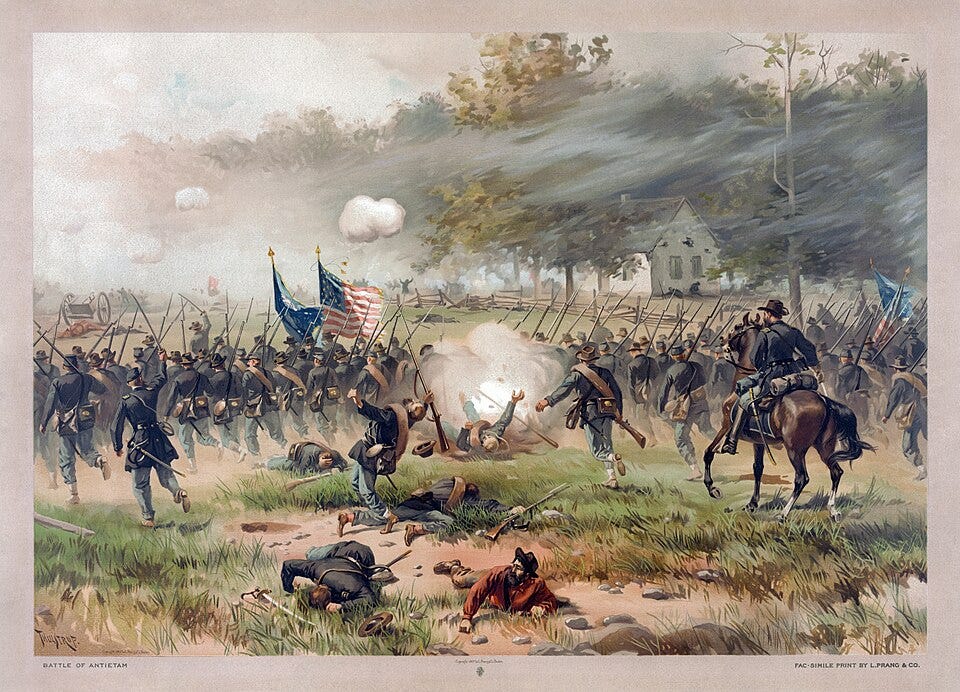
The Battle of Antietam as depicted by Swedish-American painter Thure de Thulstrup.
From “Antietam”
Book I – Robert E. Lee Finds A Wandering Horse
The middle of a battlefield lined with dead,
Where shrieks were heard and cannons roped out lead,
There was one horse without its mount, afraid,
Wandering across the bloody glade.
She strode and listened for her own voice’s sound
Amidst reverberating, pock-marked ground,
And wails of those deserted by their kin;
Near ground divided from her metalled feet,
The earth turned vomitous, while indiscreet
Were hands apart from arms, and bones freed skin.
A year before the horse had been a foal,
A filly free to run a broken knoll —
Drought-brown fields and half-filled rivulets
Where geldings paced, while sires and mares cast nets
To find their mates — though now the sires were gone,
Taken surely as that morning’s dawn
And never knelt she by a brood-mare’s knee.
And here they were, some wearing tattered hoods —
Blinders which hid no noise within the woods
While now there came — what? — Traveller with Lee.
The horse knew not the meaning of men’s words,
No better than the secret speech of birds;
But manifest were qualities displayed —
As calm or poise amidst an enfilade:
The moral attributes we call command;
And Lee she saw possessed a soothing hand,
A voice whose signal notes were a placid gray;
How rarely gold or black or ever red;
His touch seemed to pacify the dead
Whose ranks outnumbered then those eyeing day.
Her mount, her rider, after driving her all night,
Had advanced sun-up and been shot first light
And three hours now she’d tarried on the field
Convinced a man, so god-like, should have healed,
But where he was she did not know and war
About made men flee company and corps;
Hooves raw and breathing stifled, she was free —
Save stench of liniments and of gun-smoke
Matched sights of boots moved from unmoving folk
By men through malt-jugs given bravery.
Along the path of march, haphazard lines,
She had seen many footsore men put twines
Around their splintered soles to hold the leather —
And seen them eye the clouds and judge the weather —
And seen, too, others lacking shoes at all
Who barefoot grasped death’s near approach, its call,
Not through His Calvary, but cavalry,
Looking then with a brimming resentment
For Stuart’s men, conceited but absent,
Off courting debutantes of ‘63.
She knew the infantry stood near — in line —
For shouts came right, while left lay local kine;
The troops in thousands she’d seen pass at right
As they’d raced, sleepless, cross swamps, day and night,
With morning cold and thunder — but no rain —
That eerie lack — and now faced with shot-chain,
By casement-fire, and short of ligatures,
Doctors, nurses, shot, water, biscuits, meat;
(This campaign promised as an Army’s cures) —
Now Antietam, the creek, blocked their retreat.
Bodies had not begun to putrefy,
And never having seen a human die,
She wondered what was most deserving fear
Her rider taken on a stretcher-bier
Or else a land with noise in place of sun
And caustic smells — ash, tar, collodion —
Unknown before and hinting of strange fate
Or dreams that told of worlds to yet await;
But then — with all that night upon the day —
There, then, dismounted Lee to tame this bay.
Book II – Three Days Before: James Longstreet
The Council of Confederates were there —
There in one room but chairs and tables bare;
To talk of Lee’s intents one week before,
To weigh and judge and measure coldly war;
Lee stood; near Ewell, Pickett, Hill and Hill
And he famed for the violence of his Will,
Professor Jackson of First Manassas —
Defender of the Shenandoah’s passes;
He who most seemed to hold within a flame;
There was, they said, in him mixed man and beast;
The mind, so strong and supple, had earned fame,
This avenging angel of the East;
But that was long ago — at V.M.I. —
Where even then he’d gaze on wheat and rye
And track and tablelands that stretched down below
Awaiting hours when killing fields he’d sow —
Or so they said; but now, he brooded just
In listening to the one supposed august.
Lee talked, as always, with a solemn grace
Of honor, tradition and due regard
They might display, again, in moving hard;
His usual reserve shone from his face;
You sensed that might precede His Kingdom Come.
Outside one vaguely heard a drummer drum
A bugle sound and practice of parade,
The noises of camp in a still, still glade;
The morning quiet made them restless then
And Longstreet, Hood, Rodes, Gregg, McLaw — those men
Who would serve Lee and execute his will —
Listened, and listened more in their unease
For what that even, soothing voice said still
Of ceaseless attack against their enemies.
Upon the table lay a map displayed;
Their maps were crude; not charts by survey made —
Those were the North’s to have — the North’s alone —
Just Stuart’s sketch, with swamps, hills, rivers shown,
Not one town greater than a county seat;
Their woolen uniforms itched in the heat;
Outside they heard mosquitoes’ raids,
Raids proven more deadly than McClellan
Had been in marching up to Richmond when
They could have won all — but for Hill’s brigades.
So perhaps they recalled the Seven Days
Concluding with matched death and useless praise;
The so near chance to crush the Union main
Denied by Hill’s wrong maps; none could complain;
Though Washington had fine maps, scores (no whines),
And engineers, both survey corps and mines;
While buzzing yellow-jackets, wasps and fleas,
Were even in this room, with all its sweat,
And windows opened, so some air they might get
To cool arms pustulating with disease.
Yes, it was true. Nor was it just the bites
Bearing, at times, yellow-fever but sights
Of rodents eating on the hard-tack stores,
And Captains’, Majors’, Colonels’ sores
From women’s visits to the camp; and lice,
(A Major there’s shorn scalp had been its price),
And cholera, of course, most fatal still
Had decimated, or even more reduced
Their ranks, as now the buzzing spoke to will:
The need to settle things in Lincoln’s roost.
A slave owned by the woman of the house
Brought water they ached both to drink and douse;
They waited though for Lee to raise a toast
Inspired by chivalry to some grand boast,
But too, afraid to drink this fruit of rain
Because they knew no doctor could find a vein
To oust a poison; while the woman seemed
A friend — there came her slave — you weren’t sure;
Was something odd? How his eyes truly gleamed!
Was toasting hazardous or de rigeur?
How had such worthy manners so decayed?
Was something lacking in the world they’d made?
Could slaves be more than water-carriers?
Why all must see that there were barriers!
Would even Brown, John Brown, have wanted this?
Though now was not the time to reminisce;
They had to keep close watch upon the slaves,
Escaped they were a legion on the field,
An extra army for the North to wield:
A source of knowledge and for Southern graves.
James Longstreet thought these thoughts, but did not speak
Well-knowing acknowledgment they’d judge weak,
And meek a general could never be;
He would affect the air of mystery,
Just listening as the cups set forth assize
And Stonewall, with accusatory eyes,
Drank deeply of his vessel and looked around
Inquiring of their manhood that they’d paused,
Watching steadily pewter-cups be downed.
Who’d known all this could be by rumors caused?
They’d heard a captured sailor talk of spies,
Of moles among the slaves and of disguise,
Men able to put arsenic in a drink
Or in their fare — and what must they then think?
Lee gestured: cigars filled a humidor;
The boy, once busied serving petit-fours,
Smiled broadly — why? — and ladled out more to sip;
Did it taste strange? Or was it of bad wells?
Had cisterns been befouled by Union cells?
When to believe and not believe a tip?
So Longstreet wiped his lips and eyed the signs —
The chart was marked with criss-crossed lines,
Gorges, river-crossings, sites for entrenchments
In groves where batteries grew forest dense;
Plain marks for what made men beseech Mary;
The map was crowned by Harper’s Ferry,
The union’s greatest arsenal, the sea
That they like sailors sought a passage to;
They would go to it like Bartholomew
Crossed deserts to the shores of Galilee.
The slave retreated; Longstreet thought again:
Why were they entering this Lions’ den?
How many deaths justified those captured guns?
Would they be remembered as Napoleons,
Great fighters who procured a mighty haul,
Riches in metal and machines that Saul
And all the ancient kings could never match
Given their subjects’ toil of a thousand years?
With these dreams, he recalled the chandeliers
Of home while eyeing now a roof of thatch.
Through one long year of war they’d only won
And sat not far from where they’d first begun,
Their enemy enlarged, well-fed, well-clothed,
While soldiers’ loves to others were betrothed;
Lee though seemed crisp, his uniform pressed fresh,
Pipe full, cheeks smooth, like Christ’s in a crèche.
Grown hungry, Longstreet smelled the tobacco,
And weighed the plan; the army would divide,
One piece would seek to gain the conflict’s tide
Reversing Harper’s Ferry’s weapons flow.
His battalions, meantime, exposed, would ford
A river and pause, waiting for the hoard;
Brown waters at their backs, the army split,
The Union howitzers in range to hit,
The North’s brigades within the Fort a host -
All this to finish in two days at most;
Lee spoke so surely though in that soft voice,
A voice which made you listen, crouched ahead,
Certain: at once at ease with what he said;
A tone that strangely robbed you of a choice.
Thick drafts of tobacco caused Longstreet’s cough
As Lee, assuming his role as philosophe,
Drew deep and talked of Baron Jomini,
Admired Swiss theorist of the infantry
Who’d wrote on war and served both Bonaparte
And Nicholas — they said — with lion’s heart;
Lee noted Austerlitz and Marengo
So none might fear: “Great armies shan’t lie low
And wait,” he said, “they move and gain a start.”
At West Point Longstreet, too, had joined the club,
(To be denied admittance was a snub),
That studied Napoleon and read the Baron,
Desirous to become to Moses Aaron,
He who gave voice, tone to divine precepts,
First principles, which they, elect adepts,
Could work out with their vast arrays of men,
Could harmonize designs, new laws of war;
Such excitement there had been; as though a door,
Long sealed, which opened, they peered through again.
Lee made it all so grand! And yet — what’s wrong?
James Longstreet remembered a long past throng,
A wedding party and tunes poorly sung
By his friend, Grant; drinks drunk, bouquet long flung,
Night come; recalled Grant’s reasons why he’d never joined,
Disdaining Napoleon the death he’d coined.
Lee made it sound so fine! But would it be?
Near twenty years were passed since Grant’s affair
At which he’d been best man; he’d had more hair;
Now he found himself amidst Gethsemane.
Their cause seemed just; the risks of change were great;
Should chaos be his children’s sole estate?
And was his duty, past his troops, not family?
This seemed implicit in the will of Thee.
You took your bride before the Hand of Him,
Producing babes through grant of seraphim,
By miracles and powers beyond man’s ken,
Accepting much was not to man revealed,
Or would not be till earth’s own bells pealed
And in affliction brought all home, dead then.
Their views of Lee’s design they’d now unfold:
That McLaws, Early, Jackson all were sold
James Longstreet saw; he gazed then in a wider arc.
Who’d question it? Lee was their patriarch,
The one who would like Moses make them free,
(While, true, yes, keeping men in slavery);
Was even one among them unconvinced?
Why were their eyes so glad for such a scheme?
When union balls fell those same eyes winced,
While claiming doubts with oaths which don’t redeem.
One day back Longstreet had spoke to Lee
Alone and warned of likely catastrophe,
In splitting up the army into four
The Potomac behind, at the Union’s door;
He’d praised the General for jeu d’esprit
And left; Returning more to disagree,
He promptly heard within Lee’s tent the voice
That told him matters were decided now —
The pronouncement was not as he would vow —
Stonewall’s pleased look meant battle was the choice.
Abruptly Longstreet thought of home — and wife —
And all the things which brought him to this strife:
Choice to attend West Point and then to stay
When others left the ranks for better pay;
He thought back to first fights, at Monterey
And Chapultepec; the Mexicans wore gray;
Lee’d heard him at the tent address an aide
And asked him in with Stonewall already there
Staring at him with that narrow stare;
That tent was no relief for all its shade.
He’d been surprised by this and unprepared;
They were both sure, and one could not be scared;
He could see, too, how they envied his height,
Regarding looks he little liked with spite;
They would tell him; their plan fait accompli.
Jeff Davis’s wish would wake at reveille:
A victory to gain the aid of France.
Front lines would lead their raids of Maryland,
Revolting slavers aiding their advance;
Invading armies were His scourging hand!
It was thought through, conceived like earths complete;
Lee, god arraigned upon his Judgement-Seat;
And they, the Council of Confederates,
Were killing angels who by this god sits;
As Longstreet listened then he ceased to doubt,
The enemy was tardy, prone to rout;
The harvest corn would feed both man and horse
While spies with secret sympathies were eyes
And greater victories would mobilize
New ranks who’d bring them even greater force.
Yet, for all this, he thought a moment then —
Against these hopes — of vows to watch his men;
And stranger, he knew not why, of long before,
That hour he learned his father was no more;
Bright sun, bright skies, small clouds; he’d flown his kite;
Recalling how friends were then so polite,
A day in September at summer’s end,
Much like this one but thirty years apart;
He’d been just twelve; he’d ten kids now to tend
And that wife whom he loved with all his heart.
Book III – The North: Lincoln Visits The Telegraph Room
As Stonewall cast down doubts, Abe Lincoln walked.
The President perceived he might be stalked,
But thought it sage to not give voice to fears
Lest Death should think to claim of him arrears
Within a city of slave-holding males
Of whom but one might mete him Christian nails
Without a cross but just a gun in hand,
Should such a notion ever cross his mind;
So Lincoln stepped past porticoes designed
To herald wealth and grandeur for the land;
And passed he then by ash-white architraves,
White capitals and beige pilasters in waves,
By windows with bright bunting — red, white, blue;
By equipages built for the moneyed few,
Gilt-handled carriages with their iron spokes
And stallions wreathed in bells on velvet cloaks;
Watching lest manure get upon his stick,
He crossed the crowded street unnoticed,
Alerting sentries only with his wrist:
Saluting opened doors free rhetoric.
The Winder Building’s steps he climbed by twos,
Racing past stacks of ordnance and piled fuse,
To reach where army telegraphs arrived,
The room in which hopes plummeted or thrived.
Here was the word; here was the Western news,
Tidings of Grant’s complaints about the Jews,
Intelligence of McClellan’s delay,
Of generals requests for new commands
And larger armies; word of roaming bands
Raiding and vanquishing troops dressed in their gray.
This office — just five men — rose to salute;
Irked by the itching of his morning-suit,
Lincoln signaled back, trying to read faces,
Wishing that present were a woman’s graces;
Such pale, poor skin they had; how much a dress
On even quite plain girls worked to impress
And helped him bear the burden of the word,
News that meant he’d sent scores each dawn to die —
Sent after crowds of Generals conferred
Claiming Lee’s armies they’d now crucify.
This is a worthy effort, but an unnecessary one, in my view (having made a stab at the same kind of project thirty years ago.) Epic poetry arose at a time when the rhythms, rhymes, and tropes of epic poetry were needed to help the bards remember all the elements of great stories that people wanted to hear. But the purpose was always telling the story, and hearing the story.
Nowadays, we are largely literate, and the hexameters or other line structures are now static rather than music. We have shifted to the long epic novel as our means of receiving the long, complex narrative.
So what are our epics now? They can be beautifully or clumsily performed -- as they always were. And they can, like Middle English romances, be a historical-- i.e., it doesn't matter if the events really happened or could happen, as long as the truth of the story is upheld within the text.
So we have fantasy epics like Harry Potter, Game of Thrones, Lord of the Rings, Stormlight Chronicles. Futuristic epics like Dune, Foundation, The Stand. All of these have the scope and feel of the Great epics without burdening writers and readers with factuality or verse forms.
And a few writers have tackled the Matter of America. I think the greatest of these is Conrad Richter's The Awakening Land (The Trees, The Fields, The Town), which, as American epic should, focuses on lives of private citizens who are swept up in great events. Democratic heroism.
I have my own entry in the Matter of America, my Tales of Alvin Maker, which began as an epic poem until I realized that, unlike Homer's work, it would never have an audience even if I did it brilliantly, because we don't receive our significant stories that way.
I also suggest that William Shirer's The Rise and Fall of the Third Reich was an American epic, though the topic is our worst enemy since our founding.
I would also nominate Bruce Catton's Army of the Potomac trilogy, which, like the Iliad, focuses on one aspect of the Civil War, in this case Lincoln's forlorn search for a fit commander for his most crucial army, the one that had to protect the North's capital and defeat the South's great champions.
I regard all these works as serious epic literature, using the forms in which the public has been trained to receive their most significant stories. And I believe that your epic is far likelier to receive the attention and influence you seek (and deserve) if you tell it in narrative prose.
Remember that Lord of the Rings was intended to be the great English Epic, though it contains nothing of the Matter of England. Tolkien had mastered an updated version of the Old English epic verse form, which he uses for all of Tom Bombadil's speeches, so his use of plain prose elsewhere is not because he could not master the form. It is because there is no point to epic if its audience is not willing to receive it.
So, while appreciating the nobility of your poetic venture, I suggest that you prioritize story over form. It is the plain tale, plainly told, exploring why the great events happened as they did, that makes an epic Matter, not obedience to forms invented as mnemonic aids in a preliterate era.