
Trump Blinked With Iran
He Had "The Cards" - Why Did He Negotiate Such A Bad Deal?

When Ukrainian leader Volodymyr Zelensky came to the White House last year, Donald Trump dressed him down. Trump insisted that Zelensky had to go along with his demand that Ukraine accept a costly deal to supply the U.S. with rare earth minerals. That, Trump said, was because Ukraine “didn’t have the cards.”
Trump meant that Zelensky’s armies were battered, and he was like a poker player sitting at the table without a straight, flush or even two of a kind in his hand.
It seems that Trump was very wrong about Zelensky and the Ukrainian military. That mistake is defensible. Trump was relying on what his aides had told him.
Less excusable is Trump’s handling of recent negotiations with Iran. Trump had the cards. He was holding the equivalent of a full house. Iran’s economy is collapsing. As I noted previously, inflation is getting out of control, and it’s been printing something on the order of $10 billion a month in fresh currency. That’s in an economy whose total output is now less than $400 billion per year. The most recent month to month reports show Iran’s annual inflation rate is approaching 89%, and that actually understates the problem as the calculation of those figures allows for the substitution by consumers of lower-priced goods. Moreover, the effects of the recent spate of money-printing are only starting to be felt.
In addition, the U.S. and Israeli air forces have destroyed most of Iran’s air defenses, most of its navy and nearly the whole of its air force. We also killed a slew of their top leaders and were in position to demolish most of the country’s industry.
On top of all this, we had open to us a range of methods by which to assist the large part of its population that seeks the government’s overthrow. As I have also noted, we could have delivered handguns to the regime’s opponents in Tehran and other major cities. Likewise, we could have provided material support to Kurdish rebels. As well, we know how to employ disabling aerosol agents, like the hallucinogenic chemical BZ, upon its troops on Kharg Island. BZ incapacitates for three days, and since Kharg Island is the point from which Iran transports nearly all of its oil, we could have made ourselves masters of the country’s mineral wealth.
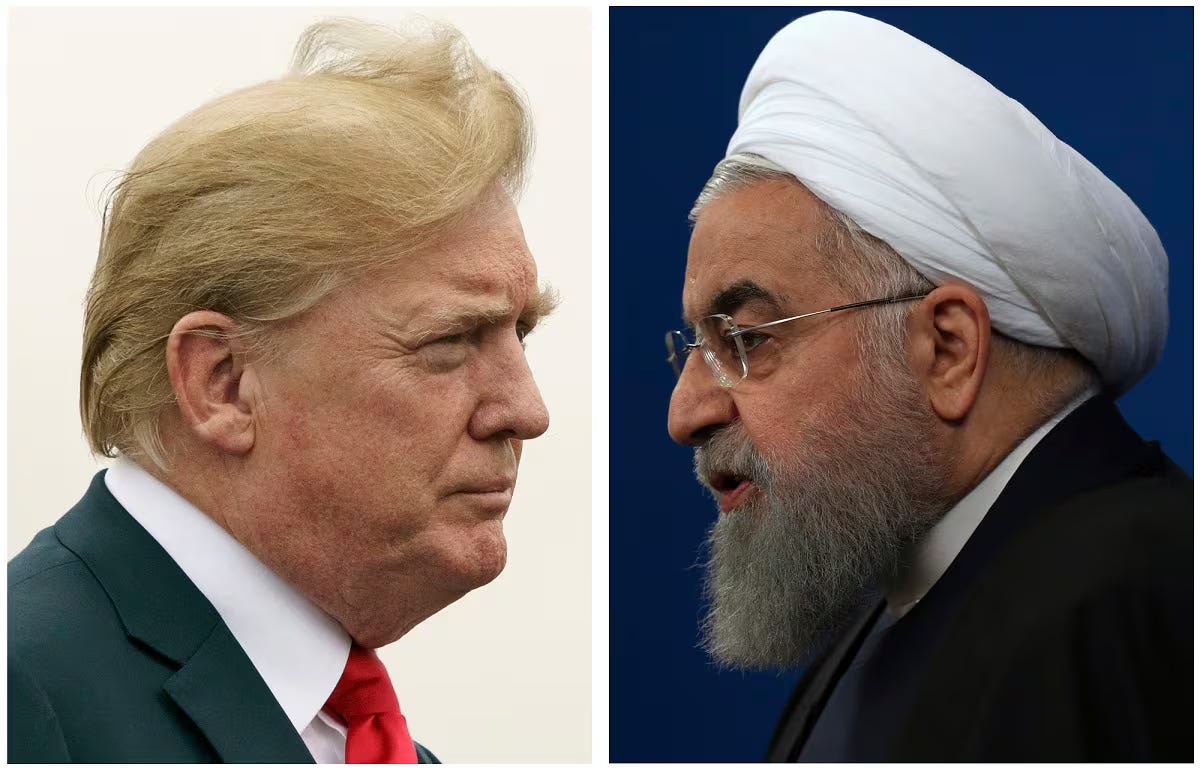
Mojtaba Khamenei (right): He hasn’t shown up for his father’s funeral. But through the Memorandum of Understanding (MoU) he’s getting badly needed cash for his country.
Yet Trump agreed to a deal that reads suspiciously like a surrender. Indeed, its terms seemed so implausible that many of us assumed at first that they were not so. The U.S. will give Iran back roughly $24 billion that had been held in escrow for decades and through a number of different Presidential administrations. We will potentially help to facilitate over $300 billion in aid that the Islamic Republic can use to rebuild its military and to assist its various proxy armies. In recent years, these allied militias have been the cause of almost all the major conflicts in the Middle East. They have fomented civil wars and attacks on governments in Lebanon, Israel and Yemen. They are also working to destabilize Iraq.
We even are permitting the Iranians to work alongside their neighbors in Oman in claiming a transit fee on oil passing through the Straits of Hormuz. In itself, this is a dangerous precedent as it may encourage other nations to try and take possession of critical sea lanes and then use these as a form of blackmail.
Altogether, it is as if Harry Truman had announced after the dropping of the atomic bombs on Hiroshima and Nagasaki that the U.S. would allow Japan’s army to remain in mainland China and to keep its colonies in Korea and Taiwan. Military victories have been followed by wholesale political retreat.
Some explanation is required.
