
Why Do People Join Cults?
A New HBO Series Provides An Intriguing Take On An Infamous Cult - But Lacks For These Vital Answers

HBO is currently running a three-part documentary that looks at one of the most infamous cults of the 1980s and 1990s. Eternal Values, as it was known, lured in some of the world’s top fashion models, stripping them of their assets as it kept them away from outside influences.
“Bring Me The Beauties” focuses on its most famous member, Hoyt Richards. For roughly a decade, Richards was the world’s highest paid and best-known male model. But he was not the stereotype of the vain ignoramus parodied in movies like “Zoolander.” In fact, Richards graduated from Princeton with a degree in Economics, and, as the series shows, he’s thoughtful, sensitive and intelligent. Yet the cult took away the millions he’d earned as a model, and at one point, with his fashion career behind him, he was living in a garage.
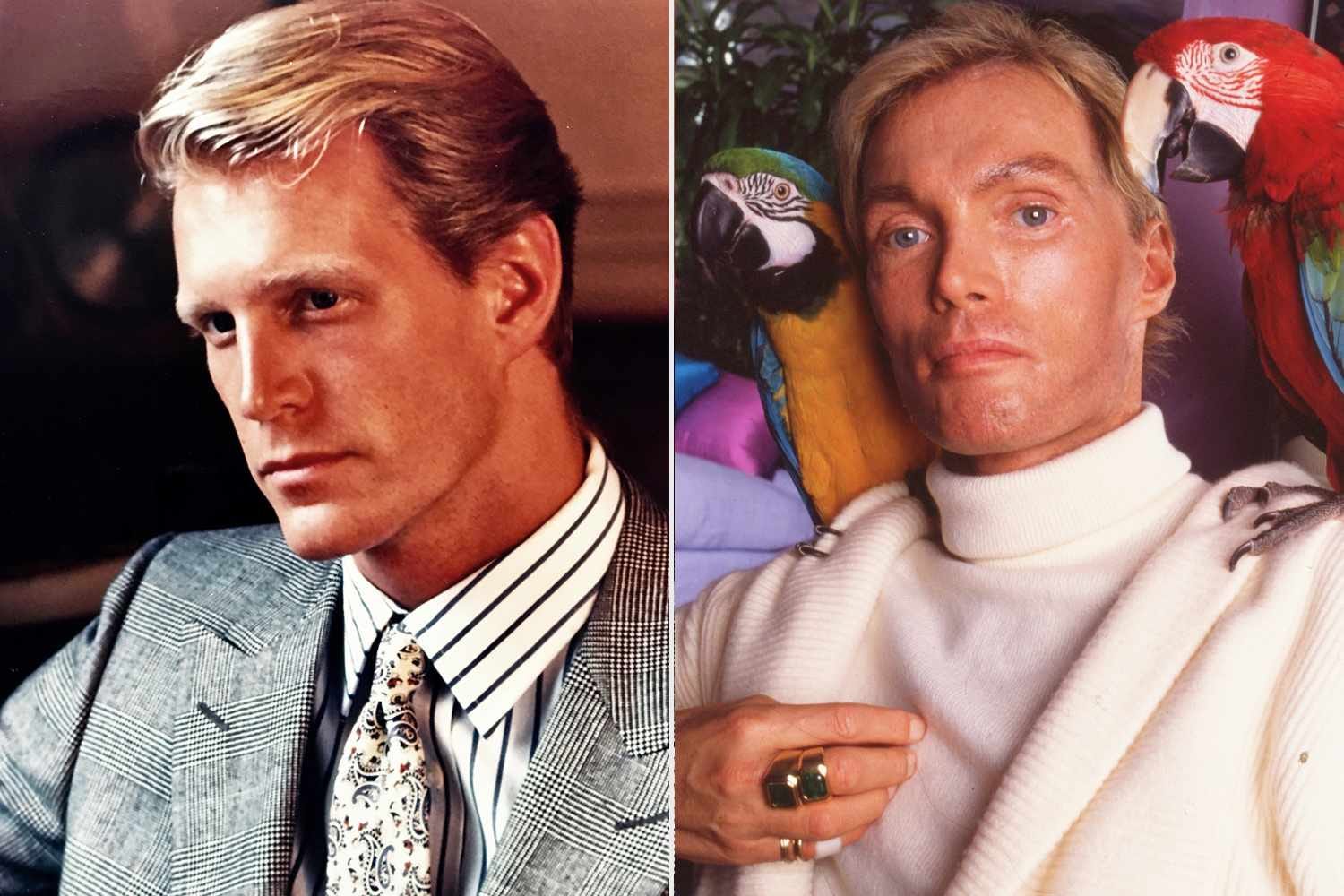
Hoyt Richards (left) and Eternal Values cult leader Frederick von Mierers (right).
The subject is of special interest to me as two graduates of my high school, Princeton Day School, also pursued successful modeling careers and entered into the cult. One was the remarkably handsome older brother of one of my eighth grade friends.
This was not the only cult that ensnared students in our school. Even more of the students — and their parents — joined the notorious Bhagwan Shree Rajneesh Movement. They would traipse about the school dressed in the strange crimson and orange robes that the cult insisted that its followers drape themselves in.
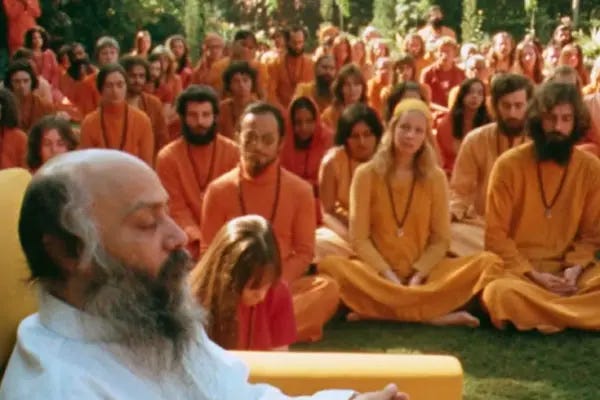
Bhagwan Shree Rajneesh and his many followers at their cult compound in Oregon.
The experience left me with a lifelong fascination with cults and an intense interest in the underlying causes that motivate people to join them.
Small though it was, Eternal Values was an especially high-profile cult, and it made use of many of the classic techniques they employ to control their followers. That can be seen through its founder, who was was a master manipulator.
Born in Brooklyn to an adolescent unwed mother named Dorothea Carroll, he was raised by some Jewish relatives in Bay Ridge. When he reached adulthood, he was a strikingly good-looking young man, and he gravitated towards Manhattan’s fashion scene. There he had some modest success as a model, albeit one with an invented backstory.
Rather than an impoverished child from a working-class section of the city’s outer boroughs, he presented himself as a German aristocrat who had renounced a great inheritance. In the same way, he changed his name from Freddy Meyers to Frederick von Mierers.
Like many children from rough and tumble childhoods, he had a keen sensitivity to others’ fears and wounds, and he used that to draw in glamorous young people who were uneasy with or alienated from their roots. His pitch was simple: His marks felt themselves to be out of place in the world because they were literal aliens from another one. While they had been born on earth, their spirits were from a far away planet called Artcurus, a planet orbiting the sun Alpha Centauri — as he himself was. This tale had been partially validated through a published account in a book by crackpot author and self-professed psychic Ruth Montgomery.
Richards was the most useful of von Mierers’ victims. Articulate and charismatic, he drew in a slew of other young models, including a frequent Vogue and Harper’s Bazaar cover-girl named Jacki Adams.

Jacki Adams: Eternal Values cult member and fashion cover model.
One of the subjects of my book The Primate Myth is the many ways in which human actions defy strict Darwinian theories of behavior. Charles Darwin never provided an explanation for why people — and some other animals like whales and dolphins — commit suicide. Nor did he explain things like anorexia and bulimia, behaviors by which humans deny themselves food and vital nutrients. Also left out of Darwin’s account is a reasoning for things like Munchausen syndrome by proxy, a mental illness in which mothers will poison their own children.
Many of the self-defeating actions that people undertake when they join cults also stand in opposition to Darwin’s writing. Thus, it’s hard to square Darwin’s assertion in the fourth chapter of The Origin of Species that, “Natural selection will never produce in a being anything injurious to itself, for natural selection acts solely by and for the good of each” with the half-knowing decision of members of the Jonestown Cult to drink cyanide-laced cups of Kool-Aid.
The Primate Myth is not an attack on the theory of evolution. It does demand, however, that we acknowledge that people and many other highly cooperative animals, like whales and dolphins, take much of their identity from being parts of a group. This means that humans are not wholly rational creatures. All too easily in our search for identity and belonging we passively absorb the beliefs of those around us, or adopt convenient notions that allow us to fit in.
